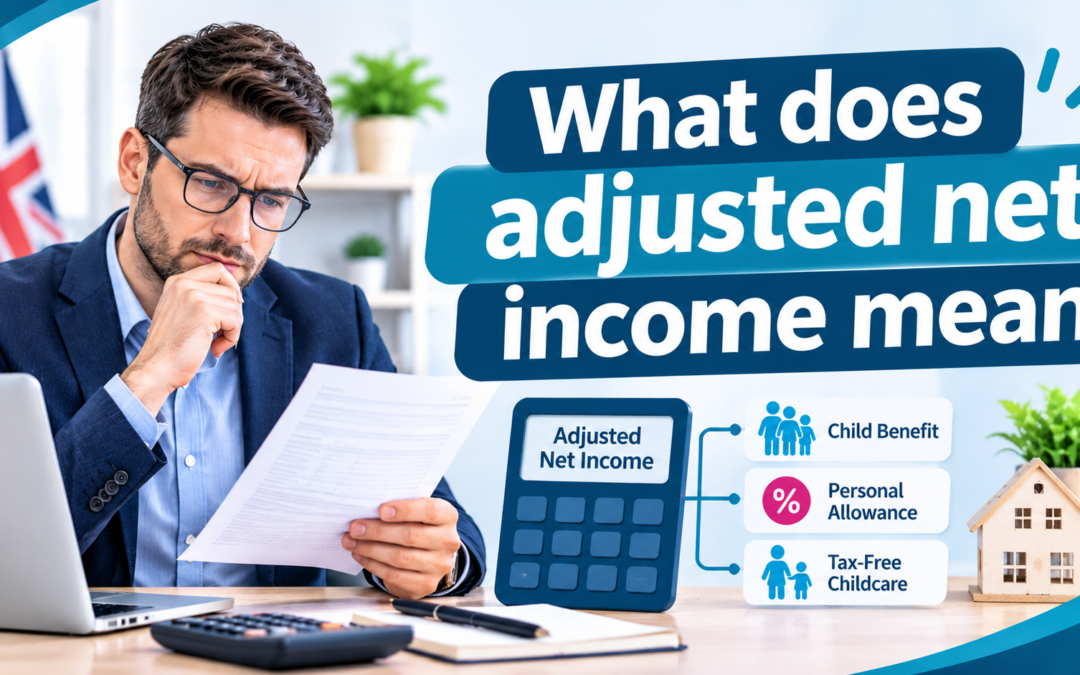
You run your own limited company. In March you declare a dividend to tidy up the year, and months later you discover you’ve lost part of your Child Benefit, some of your Personal Allowance or your Tax-Free Childcare account. The reason is one figure most directors never calculate: adjusted net income.
So what does adjusted net income mean, and why does it catch directors out more than employees? This guide explains it in plain English for owner-managers. It shows how salary, dividends and company benefits feed into the figure, why an employer pension contribution behaves differently from a personal one, and how the timing of a dividend can decide which side of a threshold you land on.
- Adjusted net income isn’t your salary, your take-home pay or your company’s profit.
- Every pound of dividends counts, including the part covered by the £500 dividend allowance.
- Company cars and other benefits in kind count too.
- An employer pension contribution only lowers your figure if it replaces salary or dividends you’d otherwise take.
- When you pay a dividend can move you across a threshold.
What Does Adjusted Net Income Mean in UK Tax?
It’s HMRC’s measure of your income for deciding whether certain allowances and benefits are reduced.
Adjusted net income starts with all your taxable income for the tax year (6 April to 5 April). Some reliefs are then taken off, along with the grossed-up value of Gift Aid donations and certain personal pension contributions. What’s left is the number HMRC compares with its income limits.
It’s easy to confuse with figures you already know:
- It isn’t your salary. Most directors take a small salary, so their salary tells HMRC very little.
- It isn’t your take-home pay. It’s worked out before Income Tax and National Insurance.
- It isn’t your company’s profit. Profit kept in the company doesn’t count until you take it out, for example as a dividend.
A different meaning in company accounts
If you’ve searched for what does adjusted net income mean and found articles about share prices and “non-GAAP measures”, those use the same words for something else. In financial reporting, a business may publish an “adjusted net income” figure that strips out one-off items from its profit. That has nothing to do with your personal tax. This guide covers the HMRC meaning only.
The Thresholds Adjusted Net Income Decides (2026/27)
Four limits depend on this one figure.
| Threshold | What happens | 2026/27 figure |
|---|---|---|
| High Income Child Benefit Charge | You repay 1% of Child Benefit for every £200 over the limit | £60,000 to £80,000 |
| Personal Allowance taper | You lose £1 of allowance for every £2 over the limit | £100,000 to £125,140 |
| Tax-Free Childcare and funded hours | You can’t claim if you or your partner expect to be over the limit | Over £100,000 |
| Married Couple’s Allowance | The allowance is reduced above the limit (older couples only) | Over £39,200 |
LITRG’s guide to adjusted net income sets out these uses. The Personal Allowance shown on GOV.UK’s Income Tax rates page stays at £12,570, frozen until 2030/31, so more directors drift towards these limits each year.
How Adjusted Net Income Is Worked Out: HMRC’s 4 Steps
GOV.UK’s adjusted net income guidance uses the same four steps for everyone.
- Work out your net income. Add up all your taxable income, then take off certain reliefs, such as trading losses.
- Take off Gift Aid. Deduct the gross value of donations: what you gave plus 25p for every £1.
- Take off relief-at-source pension contributions. Deduct the gross amount, so £800 paid becomes £1,000.
- Add back certain reliefs. A few reliefs deducted earlier, such as payments to a trade union or police organisation for death benefits, are added back.
If you want a general walk-through for employees and the self-employed, our sister guide on adjusted net income covers it in more depth. The rest of this guide focuses on how the steps apply to directors.
What Does Adjusted Net Income Mean for a Company Director?
For a director, the hard part is step 1: knowing which income counts. When a director asks what does adjusted net income mean for them, the real question is which payments from the company are included. Here’s how a typical director’s income feeds in:
| Item | Counts in adjusted net income? | Notes |
|---|---|---|
| Salary from your company | Yes | Even if it’s below the Personal Allowance |
| Dividends | Yes, in full | Including the £500 covered by the dividend allowance |
| Benefits in kind (P11D) | Yes | For example the taxable value of a company car |
| Bank and savings interest | Yes | Including interest covered by the savings allowance |
| Rental profit | Yes | Your share of any property income |
| ISA income | No | Excluded altogether |
| Employer pension contributions | No | Not your income in the first place |
| Personal relief-at-source pension | Deducted | Gross amount (net paid × 1.25) |
| Gift Aid donations | Deducted | Gross amount (gift × 1.25) |
| Profit kept in the company | No | Only counts once paid out to you |
Two lines catch most directors out. First, the dividend allowance doesn’t reduce the figure. It only means the first £500 of dividends is taxed at 0%, as GOV.UK’s tax on dividends page explains: the whole dividend still counts. Second, a company car or private medical insurance adds its taxable value even though no cash reaches you.
Dividends count in the tax year they’re paid
A dividend usually counts as your income when it’s paid, or when you’re entitled to it, not when the company earned the profit. So a dividend paid on 2 April 2027 falls into 2026/27, while one paid on 8 April 2027 falls into 2027/28. That makes timing one of the few levers a director has.
On salary alone, this director looks nowhere near the limit. Once the dividends and the car are added, a third of the family’s Child Benefit has to be paid back through Self Assessment, unless the other partner has a higher figure, in which case the charge falls on them. GOV.UK explains the High Income Child Benefit Charge in more detail. Examples are illustrative.
Employer vs Personal Pension: Which Lowers Adjusted Net Income?
This is where directors and employees differ most.
- A personal contribution to a relief-at-source pension is grossed up and deducted at step 3. Pay £8,000, the provider adds £2,000 of basic-rate relief, and £10,000 comes off your adjusted net income.
- An employer contribution paid by your company isn’t your income at all. It doesn’t add to the figure, but it doesn’t reduce it either. It only lowers your adjusted net income if the company pays it instead of salary or dividends you’d otherwise have taken.
That second point is often misunderstood. Paying a £10,000 employer contribution on top of your usual dividends changes nothing. Paying it in place of £10,000 of dividends takes £10,000 off your figure.
Worked example B: a director on £110,000
A director takes a £12,570 salary and £97,430 of dividends, so their adjusted net income is £110,000. That’s £10,000 over the taper limit, so they lose £5,000 of Personal Allowance and keep only £7,570. Here are the director’s two options for bringing the figure back to £100,000, using 2026/27 rates for the rest of the UK:
| Option | Adjusted net income | Personal Allowance | Director’s Income Tax | Change |
|---|---|---|---|---|
| No action | £110,000 | £7,570 | £27,602.47 | – |
| Personal pension: £8,000 paid (£10,000 gross) | £100,000 | £12,570 | £22,852.47 | £4,750 less |
| Employer contribution of £10,000 instead of £10,000 dividends | £100,000 | £12,570 | £21,777.47 | £5,825 less |
In the personal pension option, the director also gets £2,000 of basic-rate relief added to the pension. So £10,000 goes into the pension at a net cost of £3,250 (£8,000 paid, less £4,750 of tax saved).
In the employer option, the director’s own tax falls by £5,825. The company can usually deduct the contribution for Corporation Tax as well, whereas dividends are paid from profit that has already been taxed. Both routes count towards the pension annual allowance, which can itself be reduced for high earners; see our guide to the annual allowance taper.
These figures are illustrative. Your result depends on your other income, where you live in the UK, and your company’s Corporation Tax position.
Gift Aid: a smaller lever
Gift Aid donations work like personal pension contributions. Give £800 to charity under Gift Aid and £1,000 comes off your adjusted net income. You also claim the higher-rate part of the relief on your tax return. It only makes sense if you were going to give to charity anyway, and you must have paid at least as much Income Tax or Capital Gains Tax as the charity reclaims.
What about salary and bonuses?
Most directors keep salary low, so a salary change rarely makes a big difference. A one-off bonus does count in full, though, in the tax year it’s paid. If you’re weighing a bonus against a dividend near a threshold, both push your figure up by the same amount; the difference is the tax and National Insurance, not the effect on adjusted net income.
The £100,000 Trap for Directors
Between £100,000 and £125,140, every extra £1 of adjusted net income removes 50p of Personal Allowance. For salary, that creates an effective 60% Income Tax rate. For dividends, the combined effect is lower, but still a lot more than the headline rate. On top of that, going over £100,000 even by £1 can mean losing Tax-Free Childcare and funded childcare hours for the year.
Because directors decide when to pay themselves, they can often avoid the trap simply by planning when dividends are paid, rather than paying more tax or giving up childcare support.
Common Director Mistakes With Adjusted Net Income
| Mistake | Why it’s wrong |
|---|---|
| Looking at salary only | Dividends usually make up most of a director’s income |
| Leaving out a company car or other benefit | Its taxable value counts as income |
| Deducting the £500 dividend allowance | The allowance is a 0% tax band, not a deduction |
| Treating employer pension contributions as a deduction | They only help if they replace salary or dividends |
| Using last year’s figure | Each tax year is tested separately |
| Forgetting the other partner | The Child Benefit charge falls on whoever has the higher figure |
What Does Adjusted Net Income Mean? FAQs
Do dividends count towards adjusted net income?
Yes, in full. All dividends you receive in the tax year count, including the first £500 that’s taxed at 0% under the dividend allowance.
Does an employer pension contribution reduce adjusted net income?
Not on its own. It isn’t counted as your income, so it only lowers your figure if your company pays it instead of salary or dividends you’d otherwise take.
Is adjusted net income before or after tax?
Before tax. It’s based on your taxable income before Income Tax and National Insurance are taken off.
Does my company’s profit count?
No. Profit kept in the company isn’t your income. It only counts when you take it out, for example as salary or dividends.
Do benefits in kind count?
Yes. The taxable value of benefits such as a company car or private medical insurance is part of your employment income.
Does the dividend allowance reduce adjusted net income?
No. The dividend allowance is a 0% tax rate on the first £500 of dividends, not a deduction from your income.
Does my partner’s income count?
Not in your figure. Each person has their own adjusted net income, but for Child Benefit the charge falls on the partner with the higher figure.
What does adjusted net income mean for Tax-Free Childcare?
Each parent must expect their own adjusted net income for the tax year to be no more than £100,000. If either parent expects to go over, the family can’t use Tax-Free Childcare for that period.
Where can I see my adjusted net income?
There’s no single HMRC statement. Your accountant or tax software works it out from your Self Assessment figures, so keep a running total during the year.
Final Verdict: What Does Adjusted Net Income Mean for You?
So what does adjusted net income mean for a director? It’s the total of your salary, dividends, benefits and other income, less grossed-up personal pension contributions and Gift Aid. Small decisions near the end of the tax year, such as when to pay a dividend or whether the company pays into your pension instead, can move it across the £60,000 and £100,000 limits. Add it up before you pay yourself, not after.
- List your salary, dividends, benefits, interest and rent for 2026/27 so far.
- Take off grossed-up personal pension contributions and Gift Aid.
- Want us to check your figure before your next dividend? Call 0116 4030595 or email info@majoraccountancy.com.
Need your return filed as well? See our Self Assessment tax return service.