
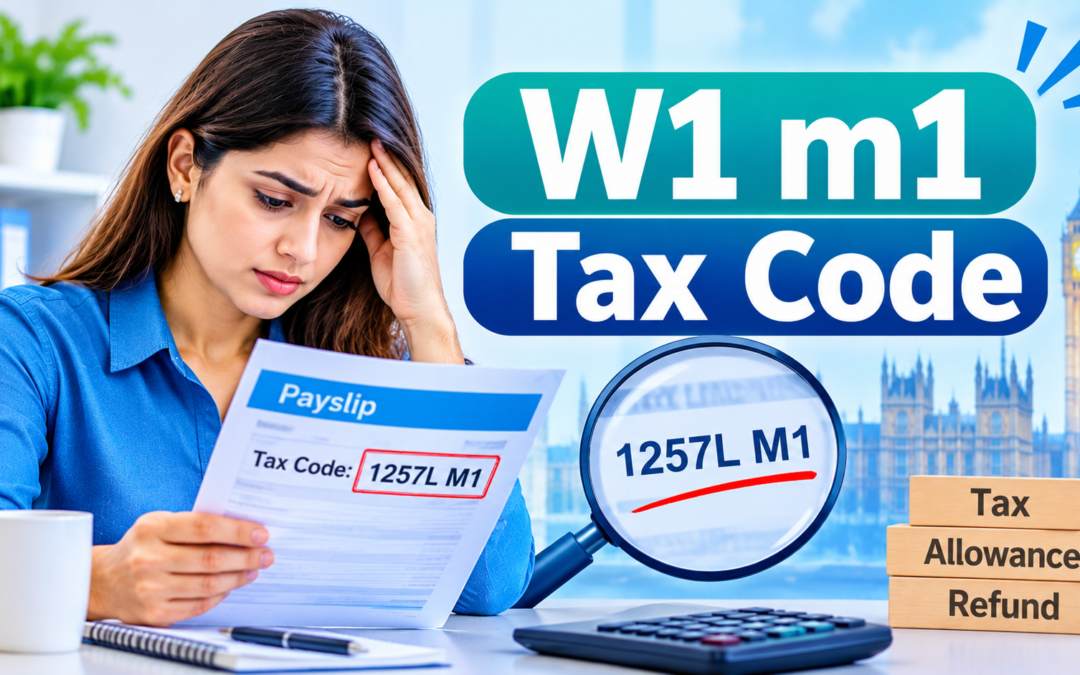
You started a new job in October, opened your first payslip and saw “1257L M1” next to your tax. The deduction looks far higher than you expected for your salary. If that sounds familiar, you’re on a W1 M1 tax code, and you’re probably paying more tax than you should, at least for now.
This guide explains what a W1 M1 tax code means, why HMRC and employers use it, and how much it can cost with a worked 2026/27 example. It shows how to get it fixed and your money back. It also covers what employers need to do when a new starter arrives without a P45.
- W1 is for weekly pay, M1 for monthly pay and X for irregular pay dates.
- You still get a tax-free allowance, but only one week’s or month’s worth on each payslip.
- Mid-year starters usually overpay on W1/M1, because unused allowance from earlier months isn’t given back.
- National Insurance isn’t affected by the code.
- Employers must use the code that matches the P45 or starter checklist, then follow HMRC’s notices.
What Does a W1 M1 Tax Code Mean?
W1 and M1 tell your employer to work out your tax on each payday in isolation, rather than looking at your total pay and tax for the tax year so far.
According to GOV.UK’s guidance on emergency tax codes, the letters after your code show which type it is:
- W1 (week 1): used when you’re paid weekly, for example 1257L W1.
- M1 (month 1): used when you’re paid monthly, for example 1257L M1.
- X: used when your pay dates vary.
Some payslips show “NONCUM” instead, meaning non-cumulative.
A W1 M1 tax code doesn’t take away your Personal Allowance. On 1257L M1 you still get £1,047.50 tax-free each month, and on 1257L W1 £241.73 each week. The difference is that each payslip only ever gets one period’s share. That’s why HMRC calls them emergency codes: they’re designed to be safe for a short time while it gathers the full picture.
Where to find it on your payslip
Your tax code usually appears near your name, National Insurance number and pay date. Look for a space and then W1, M1 or X after the code, or “NONCUM” in a separate box. You can also see the code HMRC has issued to each employer in the HMRC app or your personal tax account. If the payslip and the app don’t match, ask your payroll team which notice they last applied.
Cumulative vs Non-Cumulative Tax Codes
Most people are on a cumulative code. Understanding the difference explains almost every W1/M1 surprise.
| Cumulative code (e.g. 1257L) | Non-cumulative code (e.g. 1257L M1) | |
|---|---|---|
| How tax is worked out | On total pay and tax since 6 April | On this payslip’s pay only |
| Unused allowance from earlier months | Carried forward and used up | Ignored |
| Refunds during the year | Paid automatically through payroll | None until the code changes or the year ends |
| Typical use | Normal employment | New starters without a P45, some benefit and pension changes |
Why Have I Been Given a W1/M1 Tax Code?
There are a handful of common reasons, and most are temporary.
- New job without your P45 details: your employer doesn’t know what you’ve already earned and paid this tax year. GOV.UK says this is usually temporary and HMRC can take up to 35 days to update your code.
- Starter checklist Statement B: you told your employer this is your only job now, but you’ve had other taxable income since 6 April.
- Company benefits or the State Pension: HMRC may use a non-cumulative code until the end of the tax year so you don’t underpay.
- HMRC is still checking: while it confirms your income from different sources.
How Much Extra Tax Does a W1 M1 Tax Code Cost? (Worked Example)
The cost depends on when in the tax year you start. Mid-year starters with no earlier income are hit hardest.
Take someone who starts a new job on 1 October 2026 on £3,000 a month and hasn’t earned anything since 6 April. We compare a normal 1257L code with 1257L M1, using rest-of-UK rates and ignoring the small rounding in HMRC’s PAYE tables.
| Month | Tax on 1257L (cumulative) | Tax on 1257L M1 |
|---|---|---|
| October | £0 | £390.50 |
| November | £0 | £390.50 |
| December | £0 | £390.50 |
| January | £305.00 | £390.50 |
| February | £390.50 | £390.50 |
| March | £390.50 | £390.50 |
| Total | £1,086.00 | £2,343.00 |
Why the gap is so large
October is the seventh month of the tax year. On a cumulative 1257L code, the first payslip gets seven months of allowance, £7,332.50, set against just £3,000 of pay, so no tax is due until January.
On 1257L M1, each payslip gets only £1,047.50 of allowance, so £390.50 is deducted every month from the start. If the code is never corrected, this person overpays £1,257 by March. They’d have to wait until after the tax year ends to get it back.
When W1/M1 Means You Pay Too Little
A W1 M1 tax code doesn’t always cost you more. Sometimes it’s used precisely because you’d otherwise pay too little.
If you have a second job, a pension or a new company benefit, HMRC may keep you on a non-cumulative code until the end of the tax year.
GOV.UK explains that if you’ve paid too little, you’ll stay on the emergency code until the right amount of tax for the year has been paid. Any small shortfall left at the end of the year is usually collected through your tax code the following year or by a P800 calculation.
The same idea for weekly pay
On weekly pay the logic is identical. Someone earning £700 a week on 1257L W1 gets £241.73 of allowance each week, so £91.65 tax is deducted every week. A cumulative code would instead give a mid-year starter all the allowance built up since April, and nothing would be deducted for several weeks.
W1 M1 Tax Codes and Company Directors
Directors who pay themselves an annual salary in one go need to watch for a W1 M1 tax code in particular.
Some directors take their salary as a single payment near the end of the tax year. On a cumulative 1257L code, a £12,570 salary paid in March is covered by the full year’s allowance, so there’s no tax. On 1257L M1, the same payment gets only one month’s allowance of £1,047.50. Using rest-of-UK monthly bands, £3,980.67 would be deducted on that one payslip, and the director would have to wait for a refund.
If you’re a director on a non-cumulative code, either get the code corrected before the payday or spread the salary across the year. Directors’ National Insurance uses an annual earnings period, but that’s separate from the tax code. Our limited company directors service can help plan this.
Decoding Common W1/M1 Tax Codes
| Code | What it means |
|---|---|
| 1257L W1 | Standard allowance, weekly pay, non-cumulative |
| 1257L M1 | Standard allowance, monthly pay, non-cumulative |
| 1257L X | Standard allowance, irregular pay dates, non-cumulative |
| 0T M1 | No tax-free allowance, monthly, non-cumulative (often no P45 or starter checklist) |
| S1257L M1 | Scottish rates, monthly, non-cumulative |
| C1257L W1 | Welsh rates, weekly, non-cumulative |
| BR | All pay taxed at 20%; no allowance, so it works the same on any basis |
For what the number and letter mean on their own, see our sister site’s guide to the 1257L tax code meaning.
How to Get a W1 M1 Tax Code Fixed
Most W1/M1 codes put on because of a missing P45 can be corrected within a few weeks if you act quickly.
- Give your employer your P45 from your last job. If you don’t have one, complete the starter checklist accurately.
- Check your code in the HMRC app or your personal tax account. It shows the code HMRC has sent to each employer.
- Update your details online if HMRC has your income or start date wrong. GOV.UK explains how to update your tax code.
- Allow up to 35 days from your start date for HMRC to send your employer a new code.
- Check your next payslips. Once “M1” or “W1” disappears, the code is cumulative again.
Getting Your Overpaid Tax Back
How the money comes back depends on when the code is corrected.
- Code corrected during the year: once your employer switches you to a cumulative code, the overpayment is usually refunded automatically in your next pay.
- Still W1/M1 at the end of the tax year: HMRC reconciles your tax after 5 April and sends a P800 calculation showing any refund.
- You’ve stopped working: if you’ve left work and don’t expect to work again in the tax year, you may be able to claim a refund before the year ends. GOV.UK lists the forms (P50 or, for pension lump sums, P53) and online routes.
- Time limit: you can generally claim overpaid tax for the previous four tax years.
Be wary of texts or emails offering a tax refund with a link. HMRC doesn’t send refund links that way.
For Employers: Which Code to Use for a New Starter
If you run payroll, the code you use on day one depends on what the new employee gives you.
| New starter gives you | Code to use |
|---|---|
| P45 from previous job | The code on the P45 (keep the W1/M1 basis if the P45 shows it) |
| Starter checklist, Statement A (first job since 6 April, no other income) | 1257L cumulative |
| Starter checklist, Statement B (only job now, but had other income since 6 April) | 1257L W1/M1 |
| Starter checklist, Statement C (another job or a pension) | BR |
| Nothing at all | 0T W1/M1 |
After the first payday
- Report the code to HMRC: send it on your Full Payment Submission (FPS) under Real Time Information.
- Wait for a notice: HMRC may then send a P6 or P9 coding notice. Apply it from the next payday, including switching the “Week 1/Month 1” flag off if the new code is cumulative.
- Don’t change it yourself: don’t change a code on an employee’s say-so. Wait for HMRC’s notice, and point the employee to the HMRC app if they think it’s wrong.
If you’d like help running payroll for a small team, see our small business accounting services.
W1 M1 Tax Code FAQs
Is a W1 M1 tax code an emergency tax code?
Yes. GOV.UK calls W1, M1 and X emergency tax codes, because tax is worked out on each payslip on its own.
How long does an M1 tax code last?
For a new job, usually until HMRC updates your code, which can take up to 35 days. For benefits or the State Pension, it may last until the end of the tax year.
Will I get emergency tax back automatically?
Usually, yes. Once the code becomes cumulative, the refund normally comes through payroll. If not, HMRC sends a P800 after the tax year ends.
Does W1/M1 affect National Insurance?
No. National Insurance is worked out on each pay period’s earnings whatever your tax code.
Why is my code M1 after starting a pension?
HMRC often uses a non-cumulative code when a new pension starts, so you pay the right tax for the year across all your income.
What’s the difference between M1 and X?
Both are non-cumulative. M1 is for monthly pay; X is used when your pay dates vary.
Can my employer remove M1 without HMRC?
Generally no. Employers should apply the code from your P45 or starter checklist, then change it only when HMRC sends a coding notice.
Can I be on a W1 M1 tax code for the whole year?
Yes, if HMRC keeps it because of benefits, a pension or more than one source of income. You then move to a normal code from the new tax year.
Why does my payslip say NONCUM?
NONCUM means non-cumulative. It works exactly like W1 or M1: tax is worked out on that payslip’s pay only.
Does an M1 code affect student loan repayments?
No. Student loan repayments are worked out on each pay period’s earnings, separately from your tax code.
Final Verdict: Don’t Ignore a W1 M1 Tax Code
A W1 M1 tax code isn’t a mistake in itself, but for a mid-year starter it can mean paying hundreds of pounds too much until it’s fixed. Give your employer your P45, check the HMRC app in your first month and update anything missing. If you run payroll, use the code that matches the paperwork and apply HMRC’s notices promptly.
- Check your latest payslip for W1, M1, X or NONCUM.
- Compare your code in the HMRC app with the one on your payslip.
- Need help with payroll or a tax refund? Call 0116 4030595 or email info@majoraccountancy.com.
Need a tax return as well? See our Self Assessment service.