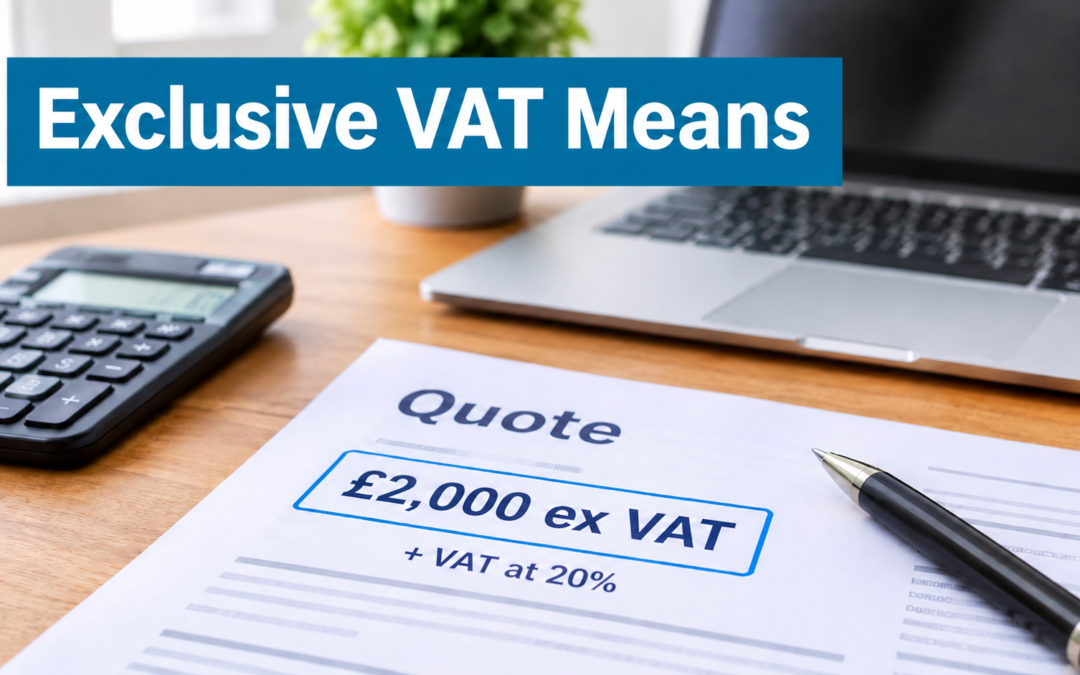
A supplier sends you a quote for “£2,000 ex VAT”, and you need to know what will actually leave your bank account. Or you’re pricing your own work and wondering whether to add VAT on top or build it in. Either way, knowing what an ex-VAT price really means matters, because getting it wrong can cost you a fifth of the price.
This guide explains the exclusive VAT meaning in plain terms, how to turn an ex-VAT price into a total at each UK rate, how to word quotes and invoices so there’s no argument later, and when you’re not allowed to show prices without VAT.
Exclusive of VAT means the stated price leaves VAT out, so VAT is added on top when the supply is taxable. At the 20% standard rate, £100 ex VAT becomes £120. VAT-registered buyers may be able to reclaim VAT on eligible business purchases under the input tax rules. Consumer prices must normally include VAT and unavoidable charges.
- “Ex VAT”, “excl. VAT” and “plus VAT” all mean VAT still has to be added; “net” usually does on business paperwork, but check the context.
- Multiply an ex-VAT price by 1.2 at 20%, by 1.05 at 5%, and add nothing at 0%.
- If a contract doesn’t say VAT is extra, a court may treat the price as including VAT, depending on the wording and facts.
- Consumers must normally see prices that include VAT; ex-VAT pricing is mainly for business buyers.
- A seller who isn’t VAT-registered can’t add VAT, so their price is the full price.
Exclusive VAT Meaning: The Short Version
Put simply, the figure you see is the price before VAT. Whoever is buying will pay that figure plus whatever VAT applies to the goods or services.
VAT is a tax on most goods and services sold by VAT-registered businesses in the UK. When a price is exclusive of VAT, the tax hasn’t been worked into it yet. The seller adds it on the invoice, collects it from you and then pays it over to HMRC.
Ex VAT, excl. VAT, plus VAT and net: the same idea
Prices are often labelled “ex VAT”, “excl. VAT”, “excluding VAT”, “plus VAT” or “+VAT”. Each of these makes clear that VAT isn’t in the figure yet, which is the vat exclusive meaning in short. On business quotes and invoices, “net” is also widely used for the amount before VAT, but it can mean other things too, so read the wording around it rather than relying on that one word. In plain terms, exclusive VAT means “add VAT to this number”.
Where you’ll see exclusive of VAT prices
You’ll come across ex-VAT prices most often in business-to-business settings: trade price lists, wholesale catalogues, builders’ merchants, equipment hire, software subscriptions for companies, and fees from accountants, solicitors and consultants.
Online shops with a “trade” or “business” account often switch to ex-VAT prices when you log in. In each case, the figure shown is the price before VAT. Where the supply is taxable and the seller is VAT-registered, VAT is added to the customer’s bill and the seller accounts for it to HMRC.
Exclusive of value added tax vs “no VAT”
A price that is exclusive of value added tax is not the same as a price with no VAT at all. “Exclusive” tells you VAT is still to come. Phrases like “VAT not applicable”, “zero-rated” or “exempt” tell you there’s nothing to add, for different reasons explained below.
What Does Exclusive of VAT Mean for the Price You Pay?
What you end up paying depends on the VAT rate for what you’re buying. The UK has three rates, set out on GOV.UK’s VAT rates page.
| Rate | Multiply the ex-VAT price by | £100 ex VAT becomes | Typical examples |
|---|---|---|---|
| Standard 20% | 1.2 | £120 | Most goods and services |
| Reduced 5% | 1.05 | £105 | Domestic gas and electricity, children’s car seats |
| Zero 0% | 1 (nothing added) | £100 | Most food, books, children’s clothes |
Zero-rated vs exempt vs outside the scope
In all three cases no VAT is added to the customer’s price, but the seller’s right to reclaim VAT on its own costs is not the same.
| Term | What it means | Examples |
|---|---|---|
| Zero-rated | Taxable at 0%; counts towards the VAT threshold, and a registered seller can generally reclaim eligible input VAT on related costs, subject to the normal rules and any restrictions | Most food, books |
| Exempt | No VAT charged, and the seller usually can’t reclaim VAT on related costs | Most insurance and financial services; some education and health services |
| Outside the scope | Falls outside the UK VAT system altogether; the treatment depends on the nature of the transaction | Wages; a genuine gift of money where the donor gets no goods or services in return |
How to Add VAT to an Exclusive of VAT Price
The maths is simple. To turn an ex-VAT price into the total, multiply it by 1 plus the VAT rate. At 20%, that’s × 1.2. The VAT itself is the ex-VAT price × 0.2.
| Price ex VAT | Rate | VAT | Total |
|---|---|---|---|
| £50 | 20% | £10 | £60 |
| £250 | 20% | £50 | £300 |
| £1,000 | 20% | £200 | £1,200 |
| £2,500 | 20% | £500 | £3,000 |
| £100 | 5% | £5 | £105 |
| £1,000 | 5% | £50 | £1,050 |
Working back from a total that includes VAT
Going the other way catches many people out. To find the VAT inside a VAT-inclusive total at 20%, divide by 6, because the VAT is one-sixth of the gross figure. At 5%, divide by 21. HMRC calls this the VAT fraction in VAT Notice 700.
The common mistake is to take 20% off the total. For a £120 inclusive price, 20% of £120 is £24, which would leave £96. That’s wrong: the VAT is £120 ÷ 6 = £20, and the ex-VAT price is £100. You can also divide the total by 1.2 to get the ex-VAT figure.
Exclusive vs Inclusive of VAT: Side by Side
The same goods can be priced either way. This table compares ex-VAT and VAT-inclusive pricing.
| Exclusive of VAT | Inclusive of VAT | |
|---|---|---|
| Wording | ex VAT, excl. VAT, plus VAT, net | inc VAT, incl. VAT, gross |
| VAT already in the figure? | No | Yes |
| Usually shown to | Business customers | Consumers |
| £1,000 item at 20% | Shown as £1,000; you pay £1,200 | Shown as £1,200; you pay £1,200 |
Café A is VAT-registered. It pays £3,000, of which £500 is VAT. If the machine is used for the café’s taxable business and the usual input tax conditions are met, it may be able to reclaim the eligible VAT through its VAT return. If it recovers the full £500, its cost after recovery is £2,500.
Café B isn’t VAT-registered. It pays £3,000 and can’t reclaim the VAT, so its cost is the full £3,000.
The same ex-VAT quote costs the two businesses different amounts. The example assumes Café A is entitled to recover all of the input VAT and doesn’t use the Flat Rate Scheme.
Quotes and Contracts: Make “Plus VAT” Clear
If you’re a VAT-registered supplier, the safest habit is to state on every quote and contract that your price is exclusive of VAT and that VAT will be added at the rate in force.
Simple wording works best, for example: “£2,000 plus VAT at the applicable rate” or “All prices are exclusive of VAT, which will be added at the rate in force at the time of supply.” Put it next to the price, not hidden in the small print.
What happens if a contract doesn’t mention VAT
Silence can be expensive. In E-Nik Ltd v Department for Communities and Local Government [2012] EWHC 3027 (Comm), the disputed consultancy rate was £850 a day, and the contract didn’t expressly say VAT could be added to it. The court found no agreement, express or implied, that VAT should go on top, so the supplier couldn’t recover VAT in addition to the agreed rate.
The supplier pointed to past dealings and to invoices that had added VAT, but that wasn’t enough. The case isn’t a universal rule: the result in any dispute depends on the contract’s wording, its other terms and the evidence. The practical lesson is to put VAT treatment in writing rather than assume it.
If the VAT rate changes during a contract
Section 89 of the VAT Act 1994 deals with this. Where the VAT charged on a supply changes after the contract is made but before the supply takes place, an amount equal to the change is generally added to or taken off the consideration, unless the contract provides otherwise. It’s sensible to state in your contract how a VAT rate change will affect the agreed price.
Invoices: Showing the Net, VAT and Total
A VAT invoice shows the ex-VAT figure, the VAT and the total separately, so your customer can see what they’re paying and reclaim the VAT if they’re entitled to.
According to HMRC’s VAT Notice 700/21, a full VAT invoice needs to show:
- a unique invoice number, the date and the time of supply if different;
- your name, address and VAT registration number, and your customer’s name and address;
- a description of the goods or services, with quantity;
- the unit price and, for each item, the VAT rate and the amount excluding VAT;
- the total excluding VAT, any cash discount rate, and the total VAT in sterling;
- the final amount payable, including VAT.
For an individual supply of £250 or less including VAT, a supplier may be able to issue a simplified VAT invoice if HMRC’s conditions in Notice 700/21 are met. It shows the VAT-inclusive total and the rate for each VAT rate, and it can’t include exempt supplies. For a supply above £250, a full VAT invoice is generally needed.
A modified VAT invoice is different: it shows VAT-inclusive values for each line, with the VAT and the ex-VAT totals at the foot. HMRC’s VAT Trader Records manual allows retailers to issue one if the customer agrees. Check the HMRC guidance for the rules that fit your type of supply.
Common Mistakes With Ex VAT Prices
Most problems with ex-VAT pricing, and with the exclusive of VAT meaning on paperwork, come from a few repeat mistakes. Here they are with the fix for each.
| Mistake | What goes wrong | Fix |
|---|---|---|
| Comparing an ex-VAT quote with a VAT-inclusive one | You think one supplier is 20% cheaper than it really is | Convert both to the same basis first |
| Taking 20% off a gross total | You understate the price before VAT (£96 instead of £100) | Divide by 1.2, or take one-sixth as the VAT |
| Quoting without saying “plus VAT” | The price may be treated as including VAT | Write “plus VAT” next to every price |
| Showing ex-VAT prices to the public | Breaches consumer pricing rules | Show VAT-inclusive totals to consumers |
| Adding VAT when not registered | You must not charge VAT | Quote one full price until you register |
Who Can Quote Prices Exclusive of VAT?
Ex-VAT pricing is normal between businesses. Selling to the public is different, because consumers must see the full price.
- Consumers: when a trader invites consumers to buy, the total price must normally be shown clearly, including VAT and any other unavoidable or mandatory charges, subject to the legal requirements and exceptions that apply.
- Goods: for goods offered to consumers, the Price Marking Order 2004 also requires the selling price to include VAT and other taxes, within its scope and exceptions, as Trading Standards’ Business Companion guide explains.
- Services: the Price Marking Order covers goods, so for services the total-price rules in the Digital Markets, Competition and Consumers Act 2024 are the main ones to follow.
- Business customers: ex-VAT pricing is common between businesses, as long as it is clearly labelled and the contract says whether VAT will be added.
If you sell to both groups, show consumers the VAT-inclusive price and make any ex-VAT trade pricing clearly labelled for business customers.
The Digital Markets, Competition and Consumers Act 2024 brought in stronger consumer-protection rules from 6 April 2025. Under the CMA’s price transparency guidance, traders must normally give consumers the total price upfront, including taxes such as VAT and other unavoidable charges.
Where the legal conditions for enforcement are met, the CMA can impose a penalty of up to £300,000 or 10% of worldwide turnover, whichever is greater. That is a possible enforcement penalty, not an automatic fine for every pricing mistake.
Not VAT-registered? There’s no VAT to add
If your taxable turnover hasn’t gone over £90,000 in the last 12 months, and you don’t expect it to go over £90,000 in the next 30 days alone, you may not need to register for VAT. Other rules can still apply, including for businesses based outside the UK, and you can register voluntarily if you’re eligible.
If you’re not registered, you must not charge VAT: don’t write “+VAT” on quotes, as your price is the full amount payable. If you register later, review existing quotes and contracts before adding VAT to prices already agreed.
On the Flat Rate Scheme?
You still charge customers VAT at the normal rate on your invoices, so ex-VAT quoting works the same way. The difference is what you pay HMRC: a fixed percentage of your VAT-inclusive turnover, as set out in GOV.UK’s Flat Rate Scheme guidance.
Exclusive of VAT Meaning: FAQs
What does exclusive of VAT mean?
It means the price doesn’t include VAT yet. VAT at the correct rate will be added, so at 20% you’d pay £120 for something priced at £100 exclusive of VAT. That is the exclusive of VAT meaning in one line.
What does ex VAT mean on an invoice?
It’s the net amount before VAT. A VAT invoice shows this figure, the VAT charged and the total you need to pay.
Is “net” the same as exclusive of VAT?
Usually, on business quotes and invoices: “net” is the amount before VAT and “gross” the amount including VAT. Because “net” can mean other things too, check the wording around it.
Does “plus VAT” mean the same as exclusive of VAT?
Yes. Both mean VAT will be added on top of the price shown.
How do I work out the price including VAT?
Multiply the ex-VAT price by 1.2 at the 20% rate or by 1.05 at the 5% rate. For zero-rated items, the price stays the same.
Can a business show consumers prices excluding VAT?
Normally not. Consumer prices should show the total, including VAT and other unavoidable charges. Ex-VAT pricing is generally for business customers.
What does exclusive VAT mean on a trade price list?
Exclusive VAT means the listed prices are before VAT. A VAT-registered trade buyer pays the VAT at checkout and usually reclaims it; a non-registered buyer pays it as a real cost.
Is an exclusive of VAT price the same as zero-rated?
No. Exclusive of VAT means VAT will be added. Zero-rated means VAT is charged at 0%, so nothing is added.
What if a quote doesn’t say whether VAT is included?
Ask the supplier to confirm in writing before you agree. If a contract is silent, a court may treat the price as including VAT, as happened in the E-Nik case, although each case turns on its own wording and facts.
Final Verdict: The Exclusive of VAT Meaning in Practice
The exclusive of VAT meaning is straightforward: the price is before VAT, and VAT is added on top. In practice, the details matter. Use the right multiplier for the rate, write “plus VAT” into every quote and contract, show consumers VAT-inclusive prices, and remember that a seller who isn’t VAT-registered has nothing to add.
- Check your quote and invoice templates say “plus VAT” next to the price.
- Make sure any prices shown to the public include VAT.
- Ask us to review your VAT set-up: call 0116 4030595 or email info@majoraccountancy.com.
Why trust this guide
- Written by Shahinur Chowdhury, UK Accountant at Major Accountancy.
- Sources: VAT rates, the VAT fraction and invoice rules link to GOV.UK and HMRC manuals; the contract point links to the court judgment; consumer pricing rules link to Trading Standards and CMA guidance. All checked on 6 November 2026.
- Examples: every calculation was rechecked before publishing, and assumptions are stated in each example.
- General information only, not personal tax or legal advice.
- GOV.UK: VAT rates
- HMRC: VAT Notice 700
- HMRC: Record keeping (VAT Notice 700/21)
- HMRC VATREC16042: Less detailed VAT invoices
- E-Nik Ltd v DCLG [2012] EWHC 3027 (Comm)
- Business Companion: Price marking of goods for retail sale
- CMA: Price transparency guidance (CMA209), summary
- HMRC VATREC16043: Retailers’ VAT-inclusive (modified) invoices
- GOV.UK: When to register for VAT
- GOV.UK: VAT Flat Rate Scheme