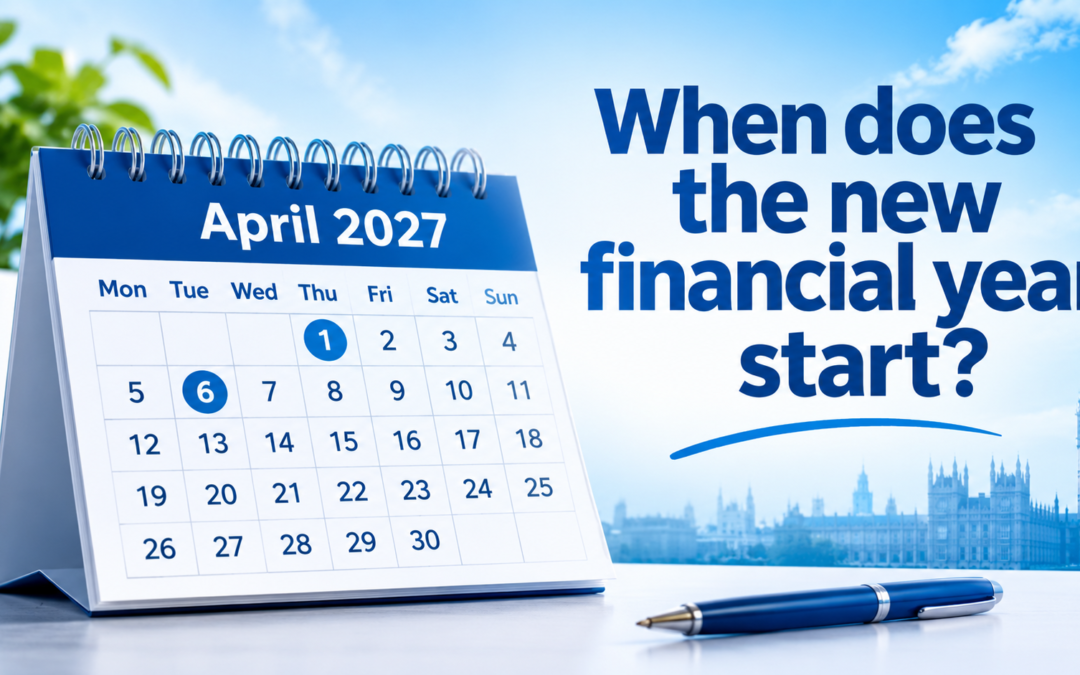
Ask three people when the new financial year starts and you may hear three different dates. Your bank talks about April, your payslip changes on the 6th, and your company accounts seem to follow a calendar of their own. None of them is wrong, because the UK runs more than one kind of year.
This guide answers the question “when does the new financial year start?” for 2027. It shows which date applies to you, how a company’s own financial year works, and what is due to change when the new year begins in April 2027.
- The government’s financial year, also used to set Corporation Tax rates, runs from 1 April to 31 March.
- The tax year for individuals runs from 6 April to 5 April.
- Each company has its own financial year, set by its accounting reference date.
- Several changes are planned for April 2027, including higher Income Tax rates on savings and property income. Most still need Finance Bill approval.
- Allowances such as ISAs and pension contributions reset on 6 April, not 1 April.
When Does the New Financial Year Start in the UK?
When does the new financial year start? For the government, and for setting Corporation Tax rates, on 1 April. For personal tax, on 6 April. For a limited company’s accounts, on the day after its own year end. The table shows the dates for 2027.
| Type of year | Runs | Next new year starts |
|---|---|---|
| Government financial year (also sets Corporation Tax rates) | 1 April to 31 March | Thursday 1 April 2027 (Financial Year 2027) |
| Personal tax year | 6 April to 5 April | Tuesday 6 April 2027 (tax year 2027/28) |
| A company’s financial year | Set by its accounting reference date | The day after its year end |
Financial year vs tax year: why there are two April dates
HMRC’s Company Taxation Manual (CTM01405) defines the financial year used for Corporation Tax rates as the 12 months starting on 1 April. Financial Year 2027 therefore runs from 1 April 2027 to 31 March 2028. Government departments, councils and the NHS plan their budgets on the same 1 April cycle.
That is not the same as a company’s Corporation Tax accounting period. A company pays tax on its own accounting periods, which can’t be longer than 12 months and don’t always match the period its accounts cover. The 1 April financial year only decides which rates apply to each slice of profit.
For individuals, Income Tax and Capital Gains Tax generally follow the tax year, which runs from 6 April to the following 5 April. National Insurance works under its own contribution rules and pay periods, so check it separately rather than assuming it follows the same year. People often call the tax year the “financial year” too, which is where the confusion starts.
Is “fiscal year” the same thing?
In the UK, “fiscal year” is just another way of saying financial year, and its dates depend on who is using it. The government’s year, which also sets Corporation Tax rates, runs from 1 April to 31 March. Individuals work to the 6 April to 5 April tax year. Companies may run their own accounting year. So when you see fiscal year UK in a document, check which of the three it means.
When Does the Financial Year Start for You?
When does the new financial year start for you? It depends on who you are and which tax or bill you’re thinking about. Use the table to find your date.
| You are | Year that matters | Starts | What resets or changes |
|---|---|---|---|
| Employee or pensioner | Tax year | 6 April | Tax code, Personal Allowance, ISA and pension allowances |
| Sole trader | Tax year (profits taxed on a tax-year basis) | 6 April | New Self Assessment year; MTD quarters if you’re in scope |
| Landlord (personal ownership) | Tax year | 6 April | Property income rates and MTD thresholds |
| Limited company | Its own financial year, plus FY for tax rates | Day after its year end; rates from 1 April | Accounts period; Corporation Tax rates per financial year |
| Employer running payroll | Tax year | 6 April | New payroll year; National Living Wage changes from 1 April |
| VAT-registered business | Its VAT return periods | Set by HMRC for your business | Nothing resets just because April arrives |
| Council tax or business rates payer | Council’s financial year | 1 April | New annual bill |
Your Company’s Financial Year: It Starts After Your Year End
A limited company doesn’t have to follow 1 April or 6 April for its accounts. Its financial year is fixed by its accounting reference date (ARD), and each new financial year starts the day after that date. So when does the new financial year start for a company? On the day after its ARD.
A new limited company’s first financial year begins on the day it is incorporated and ends on its first ARD. According to Companies House, that first ARD is the last day of the month in which the first anniversary of incorporation falls. Every later financial year then begins on the day after the previous one ended, and the ARD sets the company’s normal year end.
Take a company incorporated on 14 September 2025. Its first ARD will normally be 30 September 2026, so its first financial year runs from 14 September 2025 to 30 September 2026. The next one begins on 1 October 2026 and ends on 30 September 2027. For this business, the new financial year starts every 1 October, whatever happens in April.
The 1 April date still matters to this company, though. Its accounts follow its own year, but the Corporation Tax rates applied to its profits are set for each financial year starting on 1 April. That’s why “when does the new financial year start?” has a practical answer for companies even when their own year ends in September or December.
Can you change your company’s year end?
Yes. You can shorten or lengthen the current or previous period by filing form AA01 with Companies House, within limits on how often and how far you can extend. GOV.UK explains the rules. Changing the year end also changes the Corporation Tax accounting period, so HMRC needs to know too.
Corporation Tax When Your Year Straddles 1 April
Because Corporation Tax rates are set for each financial year starting 1 April, a company whose accounting period crosses 1 April splits its profit between the two years by days, as GOV.UK’s Corporation Tax rates page explains.
For Financial Year 2026 the small profits rate is 19% and the main rate is 25%, with marginal relief between £50,000 and £250,000 of profit. The 28 October 2026 Budget kept the main rate at 25% for Financial Year 2027 too. When rates stay the same, the split makes no difference to the bill. It matters whenever a rate or threshold changes on 1 April.
Days in Financial Year 2026 (1 January to 31 March 2027): 90 days, so £40,000 × 90 ÷ 365 = £9,863.
Days in Financial Year 2027 (1 April to 31 December 2027): 275 days, so £40,000 × 275 ÷ 365 = £30,137.
Both slices fall under the 19% small profits rate, so the total is £40,000 × 19% = £7,600. If the rate for Financial Year 2027 had been different, each slice would be taxed at its own year’s rate. This is a simplified example. It assumes the company qualifies for the small profits rate throughout, has no associated companies and has a single 12-month accounting period. Real calculations may need adjusted profit thresholds and marginal relief.
What Changes When the New Financial Year Starts in April 2027?
When does the new financial year start for the coming tax changes? Most of the measures below take effect on 1 April or 6 April 2027. Some are already law; others were announced at the 28 October 2026 Budget and still need to pass through the Finance Bill, so they could change.
| Change | Who it affects | From | Status |
|---|---|---|---|
| National Living Wage rises to £13.21 an hour (age 21+) | Employers and workers | April 2027 | Accepted by government (LPC recommendation) |
| Income Tax on property income: 24%, 44% and 49% | Individual landlords in England, Wales and Northern Ireland, subject to devolved tax-setting arrangements | 6 April 2027 | Announced at Budget 2026; needs Finance Bill 2026–27 |
| Income Tax on savings income: 24%, 44% and 49% | Savers with taxable interest, UK-wide | 6 April 2027 | Announced at Budget 2026; needs Finance Bill 2026–27 |
| Business Asset Disposal Relief lifetime limit falls to £500,000 | Business owners selling qualifying assets | 6 April 2027 | Announced; needs Finance Bill |
| MTD for Income Tax extends to qualifying gross income over £30,000 | Sole traders and landlords | 6 April 2027 | Set out by HMRC |
| Personal Allowance stays at £12,570 | All taxpayers | 2027/28 | Frozen |
| Dividend tax rates unchanged (10.75%, 35.75%, 39.35%) | Shareholders and company directors | 2027/28 | No change announced |
Official sources: GOV.UK (NLW), GOV.UK (property and savings rates), GOV.UK (MTD). Budget 2026 rate rise and BADR cross-checked with ICAEW, UHY Hacker Young and Jack Ross on 6 November 2026.
On Making Tax Digital: from 6 April 2027 it is due to apply to eligible sole traders and landlords whose qualifying gross income was over £30,000 in the 2025/26 tax year. That figure is gross income from self-employment and property before expenses, not taxable profit, so check HMRC’s eligibility rules to see whether you need to join.
One change some savers expected won’t happen. A cut in the cash ISA limit to £12,000 for under-65s had been planned for April 2027, but at Budget 2026 the government said it would keep the cash ISA limit at £20,000 for savers under 65, as Deloitte’s Budget summary reports. The change is being made through secondary legislation due before Parliament in November 2026.
Tax Allowances and Limits to Review on 6 April
Several yearly allowances start again from zero when the tax year turns over on 6 April, not on 1 April:
- ISA allowance: £20,000 a year; unused allowance doesn’t carry forward.
- Pension annual allowance: usually £60,000 for the tax year. Unused allowance from the previous three tax years may be carried forward if the conditions are met.
- Capital Gains Tax annual exempt amount: £3,000.
- Dividend allowance: £500.
- Personal Savings Allowance: £1,000 for basic-rate and £500 for higher-rate taxpayers. This covers tax on savings interest; it is separate from the ISA subscription limit.
Why Does the UK Financial Year Start in April?
If you’ve ever wondered why the answer to “when does the new financial year start?” is April rather than January, the reason goes back centuries. The year once began on Lady Day, 25 March, a quarter day when rents and debts were often settled.
When Britain switched to the Gregorian calendar in 1752, eleven days were dropped, so the Treasury moved the year end to 5 April to keep a full year. A leap-year adjustment in 1800 then pushed the start to 6 April. The Chartered Institute of Taxation sets out this history. The government’s own financial year settled on the neater 1 April.
New Financial Year Checklist for 2027
Answering “when does the new financial year start?” is only half the job. Use this checklist for the weeks either side of April 2027.
- Before 5 April 2027: use any ISA, pension or Capital Gains Tax allowance you still want for 2026/27, as unused amounts don’t roll into the new tax year (except pension carry-forward).
- Employees: check the tax code on your first payslip after 6 April, and keep your P60, which your employer must give you by 31 May 2027.
- Employers: pay the new National Living Wage from 1 April 2027, start the new payroll year on 6 April, and issue P60s by 31 May.
- Sole traders and landlords: check whether your qualifying gross income for 2025/26 was over £30,000, which brings you into MTD for Income Tax from 6 April 2027. If it does, your first quarterly update covers 6 April to 5 July 2027 and is due by 7 August 2027.
- Limited companies: confirm your own year end, check Corporation Tax rates for Financial Year 2027, and plan directors’ salary and dividends for the 2027/28 tax year.
- Everyone: save last year’s records, as Self Assessment for 2026/27 is due online by 31 January 2028.
Key dates around the start of the year
| Date | What happens |
|---|---|
| Wednesday 31 March 2027 | Financial Year 2026 ends |
| Thursday 1 April 2027 | Financial Year 2027 starts; new council tax bills; NLW rise |
| Monday 5 April 2027 | Tax year 2026/27 ends |
| Tuesday 6 April 2027 | Tax year 2027/28 starts; allowances reset |
| Monday 31 May 2027 | P60s due to employees |
| Saturday 7 August 2027 | First MTD quarterly update due (if in scope) |
For a fuller list of what’s due at the end of the year, see this guide to the end of the financial year in the UK.
When Does the New Financial Year Start? FAQs
Does the financial year start on 1 April or 6 April?
Both are used. The government’s financial year, also used to set Corporation Tax rates, starts on 1 April. The personal tax year, used for Income Tax, starts on 6 April.
When does the financial year start for a limited company?
On the day after its accounting reference date. A company with a 30 June year end starts each new financial year on 1 July.
When did the new financial year 2026 start?
Financial Year 2026 started on 1 April 2026, and the 2026/27 tax year started on 6 April 2026. The next new financial year starts on 1 April 2027.
What is a fiscal year in the UK?
It’s another name for a financial year. It can mean the government’s 1 April year, the 6 April tax year or a company’s own accounting year, depending on the context.
Is the tax year the same as the financial year?
Not quite. The tax year runs 6 April to 5 April. The government’s financial year, which also sets Corporation Tax rates, runs 1 April to 31 March.
Does the new financial year change my VAT quarters?
No. VAT return periods are set for your business by HMRC and don’t reset in April.
When does the new financial year start for council tax and business rates?
On 1 April. Councils work to the 1 April to 31 March financial year, so new council tax and business rates bills usually take effect from 1 April 2027.
When does the new financial year start for MTD quarterly updates?
MTD for Income Tax follows the tax year. If your qualifying gross income for 2025/26 was over £30,000, your first quarter of 2027/28 runs from 6 April to 5 July 2027, with the update due by 7 August 2027. You can choose calendar quarters starting 1 April instead, before your first update.
Why does the tax year start on 6 April?
Because of calendar changes in 1752 and 1800, which moved the old Lady Day year start of 25 March to 5 April and then to 6 April.
Final Verdict: When Does the New Financial Year Start?
So, when does the new financial year start? On 1 April 2027 for government budgets and Corporation Tax rates, on 6 April 2027 for personal tax, and on the day after its own year end for each limited company. Work out which year each of your taxes follows, use your allowances before 5 April, and plan for the announced April 2027 changes, while remembering several still need Parliament’s approval.
- Find your row in the “when does the new financial year start for you” table.
- Note the April 2027 changes that affect you.
- Ask us to plan your year: call 0116 4030595 or email info@majoraccountancy.com.
Run a company? Our limited company directors service covers year ends, Corporation Tax and dividend planning. For personal returns, see our Self Assessment tax return service.
Why trust this guide
- Written by Shahinur Chowdhury, UK Accountant at Major Accountancy.
- Sources: the financial year definition comes from HMRC’s Company Taxation Manual, and company year-end rules from Companies House and GOV.UK, all checked on 6 November 2026.
- Budget changes: April 2027 measures link to GOV.UK where an official page exists, are marked “announced” until they become law, and were cross-checked against independent Budget summaries.
- Review: every date and weekday, and the Corporation Tax example, were recalculated before publishing. The guide is updated when HMRC confirms new rates.
- General information only, not personal tax advice.
- HMRC CTM01405: Financial year
- GOV.UK: Corporation Tax rates
- Companies House: Accounting reference dates and periods
- GOV.UK: Change your company’s year end
- GOV.UK: Making Tax Digital for Income Tax eligibility
- UHY Hacker Young: Autumn Budget 2026 summary
- Jack Ross: Budget 2026 summary
- GOV.UK: National Living Wage to rise to £13.21
- GOV.UK: Changes to tax rates for property, savings and dividend income
- ICAEW: Budget raises property and savings income rates
- Deloitte: Retaining the cash ISA limit at £20,000
- Chartered Institute of Taxation: The 5 April tax year end