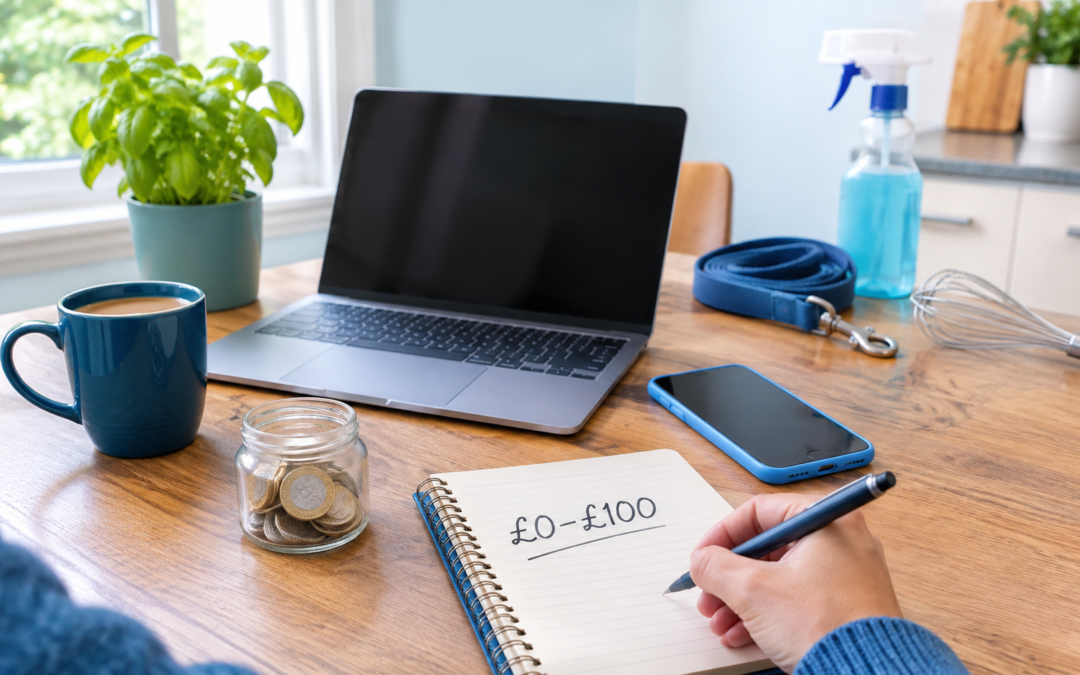
You want to earn money from home, but you don’t have thousands to put in, and you’re not sure what HMRC will expect from you. That’s a common starting point.
The good news is that the cheapest business to start from home UK can often launch for under £100, as long as it sells your time and skills rather than stock. There’s no single cheapest option for everyone, though: the right one depends on what you can already do and the kit you already own.
This guide sorts low-cost ideas by how much you need to spend, separates one-off costs from monthly ones, and lists the checks or licences each idea needs. It then walks through the tax steps for 2026/27, with a worked example, so you can start cheaply and stay on the right side of HMRC.
No one business is cheapest for everyone, but the cheapest business to start from home in the UK is usually a service you can already do, such as proofreading, tutoring, dog walking, cleaning or admin support. Many launch for under £100. If your total gross trading income goes over £1,000 in a tax year, register for Self Assessment.
- Skills-based services are the cheapest to launch because there is no stock to buy.
- Compare one-off and monthly costs separately; a “free” idea can still carry subscriptions.
- Some ideas need a check or registration first, such as a DBS check, food business registration or Ofsted.
- The £1,000 trading allowance is tested on gross income from all your trades combined, not profit. Above it, you must register for Self Assessment.
- Most home businesses start as sole traders, which costs nothing to set up with HMRC.
What Is the Cheapest Business to Start From Home UK?
The cheapest business to start from home in the UK is one that sells a skill you already have, uses equipment you already own and needs no premises. Writing, admin, tutoring, pet care and cleaning all fit that description, which is why they appear on almost every low-cost list.
Four things keep start-up costs down:
- No stock: you sell hours, not products, so nothing sits unsold.
- Kit you own: a laptop, phone, car or cleaning tools you already have.
- No premises: you work from your kitchen table or at the client’s home.
- Low licence costs: few or no official checks before you can trade.
One-off costs vs monthly costs
Many guides add up very different costs as if they were the same. A £60 first aid course is paid once. A £15 software plan is paid every month and comes to £180 over a year. When you compare ideas, look at both figures. The cheapest business to start from home is the one with low costs on both lines, not just a low first payment.
Cheapest Home Businesses by Start-Up Budget
Looking for the cheapest business to start from home in the UK? The table groups ideas by how much you would typically spend before your first sale. The figures are our rough estimates, not quotes, and official fees are linked where they apply.
How the estimates work: they assume that, like most people looking for the cheapest business to start from home in the UK, you already own a phone, a laptop and basic household kit. One-off costs cover simple equipment, any short course, first marketing (cards or a basic listing) and official checks. Monthly costs cover software, platform plans and insurance premiums. Insurance prices vary a lot by provider, cover level and what you do, so get your own quote.
| Idea | One-off (illustrative) | Monthly (illustrative) | Check or licence first |
|---|---|---|---|
| Budget £0 to £100 | |||
| Proofreading or copywriting | £0–£50 | £0–£15 | None |
| Virtual assistant | £0–£50 | £0–£20 | None for general admin |
| Online tutoring | £20–£80 (DBS, any training) | £0–£15 plus platform fees and insurance | DBS check may be requested |
| Dog walking or pet sitting | £30–£100 | Insurance, roughly £5–£15 (estimate) | Licence if you board pets at home |
| Domestic cleaning or ironing | £40–£100 | Insurance, roughly £5–£15 (estimate) | None |
| Reselling items you own | £0 | Platform fees per sale | None |
| Budget £100 to £500 | |||
| Home baking or cake making | £100–£400 | Ingredients and packaging | Free food business registration with your council, 28 days before trading; check local requirements |
| Bookkeeping | £300–£500 (a bookkeeping course and software set-up) | £15–£40 software | Anti-money laundering supervision (HMRC or a professional body) |
| Handyperson or gardening | £150–£500 tools | £5–£20 insurance | Trade rules for gas or electrical work |
| Mobile hair or beauty | £200–£500 | Products and insurance | Council licence for some treatments |
| Print-on-demand shop | £0–£150 design tools | Shop plan and fees | None |
| Budget £500 and over | |||
| Childminding | £400–£800+ | Food, toys, insurance | Ofsted registration, DBS checks, first aid |
| Photography or video | £500+ if you need a camera | Editing software | None |
Illustrative ranges, not quotes. Official fees: DBS fees from 5 October 2026; GOV.UK childminder costs; checked 3 November 2026.
Small Business Ideas UK: The Best Low-Cost Picks Explained
If you’re still choosing the cheapest business to start from home in the UK, these small business ideas UK readers ask about most can each start on a modest budget. For each one, here is what the work involves, roughly what it costs and the one thing to sort out before your first customer.
Proofreading and copywriting
You check or write text for websites, students, authors or small firms. A laptop and a good grammar tool are usually enough. Sort out first: a short portfolio, even if the first pieces are free samples for people you know.
Virtual assistant
You handle emails, diaries, invoices or social media for busy owners. Costs are mostly the tools clients already pay for. Sort out first: a simple contract that says what you do, how fast you reply and how you handle their data.
Online tutoring
You teach a school subject, a language or a skill over video calls. Parents and tutoring platforms may ask to see a DBS check. Since 5 October 2026 a Basic check has cost £20, while some roles qualify for a Standard or Enhanced check at a different fee (£41 for Enhanced). Sort out first: which level you’re legally eligible for and which suits your role. Budget for any platform fees and insurance too.
Dog walking and pet sitting
Walking dogs costs little more than leads, bags and insurance. Sort out first: public liability insurance, and a council licence if you plan to board animals in your own home, as that is a licensed activity in England.
Cleaning and ironing
Demand is steady, and you can start with your own products and a basic kit. Sort out first: insurance, and how you’ll travel between jobs, since travel time cuts into what you really earn per hour.
Home baking
Selling cakes or treats from your kitchen is popular but carries more rules. You must register as a food business with your local council at least 28 days before you start trading, and registration is free. Rules can differ between councils, so check what yours expects. Sort out first: a food hygiene course and allergen labelling.
Bookkeeping
If you’re organised and good with numbers, bookkeeping can be run from home for local firms. Most of the start-up spend goes on a course and software. If your work falls within the regulated accountancy service sector, you need anti-money laundering supervision before you take clients.
That supervision can come from HMRC or from an eligible professional body, so check whether a membership you hold already includes it. If you do register with HMRC, its current fees include a £300 application fee, £400 a year per premises and £40 per person for the approval check. Sort out first: who your supervisor will be.
Which pays best?
People often search for the most profitable small business in the UK, but there is no single answer. Profit depends on your price, how many hours you can sell and what each job costs you.
Skills that clients struggle to find, such as bookkeeping or specialist tutoring, usually charge more per hour than general cleaning or dog walking. The best business to start in the UK is one where you can charge a fair rate and keep costs low from the start. Remember that the cheapest business to start from home in the UK is not always the most profitable one.
How quickly could the first customer arrive?
When you pick the cheapest business to start from home in the UK, a low start-up cost only helps if paying work follows. The table gives a rough, qualitative view of how hard it usually is to land the first customer. It is general guidance, not market data.
| Business | Start-up cost | First customer | Why |
|---|---|---|---|
| Proofreading | Very low | Medium | You need samples or reviews before clients trust you |
| Virtual assistant | Very low | Medium | Referrals and a clear service list help |
| Dog walking | Low | Low to medium | Local demand; neighbours and community groups |
| Cleaning | Low | Low to medium | Word of mouth spreads quickly in one area |
| Bookkeeping | Medium | Medium to high | Training and AML supervision come first |
| Home baking | Medium | Medium | Registration lead time and building repeat buyers |
HMRC Steps for Your Low-Cost Home Business
Whichever idea you pick, the cheapest business to start from home in the UK still has to deal with HMRC. These steps apply to most sole traders in 2026/27.
- Check the trading allowance. The £1,000 trading allowance can make a very small side income tax-free. It is tested on gross income across all your trades. You can’t use it for income from your employer (or your spouse’s employer), from a partnership, or from a company you or a connected person control.
- Register for Self Assessment once your gross trading income goes over £1,000. The deadline is 5 October after the end of the tax year in which you started, so a business started in 2026/27 must register by 5 October 2027. HMRC then sends your Unique Taxpayer Reference (UTR).
- Keep records from day one. Save every receipt and log every payment. A spreadsheet or a free app is fine at the start.
- Claim working-from-home costs. HMRC’s simplified expenses let you claim £10 a month for 25 to 50 hours of home working, £18 for 51 to 100 hours and £26 for 101 hours or more. Phone and internet are claimed separately.
- Watch the VAT threshold. You only have to register for VAT if your taxable turnover goes over £90,000 in a rolling 12 months.
- Know the Making Tax Digital dates. MTD for Income Tax applies to sole traders and landlords with qualifying income over £50,000 from April 2026 and over £30,000 from April 2027. Qualifying income means your combined gross self-employment and property income before expenses, not profit; salary, dividends and pensions don’t count towards it.
- Understand National Insurance. In 2026/27, Class 4 is 6% on profits between £12,570 and £50,270, according to GOV.UK’s NI rates. Profits below £7,105 can choose to pay voluntary Class 2 at £3.65 a week to protect State Pension years.
Sole trader or limited company?
For the cheapest business to start from home in the UK, sole trader status is usually the natural fit. Registering with HMRC is free, the paperwork is lighter, and you keep the profit after tax. A limited company costs £100 to register online at Companies House, needs yearly accounts and a confirmation statement.
A company tends to make sense later, when profits grow. If you’re weighing that step, our limited company directors service can model both options.
Proofreading is often named as the cheapest business to start from home in the UK, so here is how the tax works. Priya earns a £30,000 salary in England, which already uses her Personal Allowance. In 2026/27 she starts proofreading from home in the evenings. She spends £150 on software and a course, then £650 on advertising, a share of her phone and other running costs: £800 in total. Her proofreading sales for the year are £6,000.
Option 1, actual expenses: £6,000 − £800 = £5,200 profit × 20% = £1,040 Income Tax.
Option 2, trading allowance: £6,000 − £1,000 = £5,000 profit × 20% = £1,000 Income Tax.
The allowance saves Priya £40 because it is bigger than her real costs. Because Priya is both employed and self-employed, her Class 4 National Insurance position depends on her combined earnings, and HMRC works out any Class 4 due once she files her Self Assessment return. Her profit is below £7,105, so she could choose to pay voluntary Class 2 of £189.80 for the year (£3.65 × 52). She must register for Self Assessment by 5 October 2027.
This example assumes no other side income, Scottish rates don’t apply, and the business is a single trade. If Priya’s expenses had been more than £1,000, claiming them would have been better.
How to Start a Business UK With No Money
If you’re wondering how to start a business UK with no money, choose a service that needs nothing but your time, find the first clients through people you know, and only spend money once paying work arrives.
- Pick a £0 idea: proofreading, admin help, tutoring, dog walking or decluttering. In practice, a £0 idea is the cheapest business to start from home in the UK.
- Use free tools: a free email account, a free invoice template and a social media page.
- Start local: neighbours, community groups and word of mouth cost nothing.
- Reinvest the first earnings: pay for insurance, a website or better kit from income, not savings.
Hidden costs most guides skip
Even the cheapest business to start from home in the UK has a few costs people forget. Public liability insurance is the most common, and the premium depends on your provider, the cover you pick and the work you do, so compare quotes rather than relying on a typical figure. Platform fees also take a cut of each sale.
You may also need to tell your mortgage lender, landlord or home insurer that you work from home. Business rates don’t usually apply to a desk in a spare room. You may have to pay them if you use part of your home only for business, alter your home for the business (for example, building a treatment room), sell to customers who visit, or employ people who work there.
The cheapest business isn’t always the one with the lowest start-up bill; it’s the one that reaches a profit fastest. I’d tell anyone starting out to keep a receipt for the very first thing they buy and to note their sales from the first job. When it’s time to register with HMRC, you’ll know straight away whether the £1,000 allowance or your real expenses gives the lower tax bill. Shahinur Chowdhury, UK Accountant
Cheapest Business to Start From Home in the UK: FAQs
What is the easiest business to start from home in the UK?
The easiest is usually a service you already know how to do, such as cleaning, proofreading or dog walking. These need no premises and few or no licences, so you can start within days. It is often the cheapest business to start from home in the UK as well.
What business can I start in the UK with no money?
Skills-based work such as tutoring, admin support, writing or pet care can start with almost nothing if you already own a phone and laptop. Use free tools until the first payments come in.
What is the most profitable small business in the UK?
It varies. Specialist skills such as bookkeeping or exam tutoring usually earn more per hour, but profit depends on your prices, hours and costs rather than the type of business alone.
Do I need to tell HMRC about a small side business?
If your gross trading income from all trades is £1,000 or less in a tax year, you usually don’t, though some situations still need a return. Over £1,000, register for Self Assessment by 5 October after that tax year ends.
Do I need a licence to run a business from home?
Most home services don’t. Some do, including food businesses (free council registration), childminding (Ofsted), home dog boarding and some beauty treatments. Check with your local council.
Can I start a business while employed?
Yes, as long as your employment contract allows it. Your side profits are added to your salary for tax, and you can still use the £1,000 trading allowance unless the income comes from your employer or a business connected to you.
Should I set up a limited company straight away?
Usually not. Starting as a sole trader is free and simpler. A company may suit you later, when profits are higher or you want to keep money in the business.
Final Verdict: The Cheapest Business to Start From Home in the UK
The cheapest business to start from home in the UK is the one built on a skill you already have, with low one-off and low monthly costs. Check whether your idea needs a DBS check, food registration or other approval, keep records from the first day, and register for Self Assessment once your gross trading income passes £1,000.
- Choose the cheapest business to start from home in the UK that matches your skills, ideally from the £0 to £100 tier.
- List its one-off and monthly costs, plus any check it needs.
- Ask us about registering and your first tax return: call 0116 4030595 or email info@majoraccountancy.com.
✓ Self Assessment registration and returns
✓ Leicester-based, working UK-wide
Need your first tax return done? Our Self Assessment tax return service covers sole traders with side incomes and new businesses.
Why trust this guide
- Written by Shahinur Chowdhury, UK Accountant at Major Accountancy.
- Sources: every tax rule, threshold and official fee links to GOV.UK, HMRC or a council page, all checked on 3 November 2026.
- Estimates: start-up cost ranges are our own estimates, built on the assumptions stated under the table. They are not quotes.
- Review: figures in the worked example were recalculated before publishing, and the guide is updated when HMRC rates or official fees change.
- General information only, not personal tax advice.
- GOV.UK: Tax-free allowances on property and trading income
- GOV.UK: Register for Self Assessment
- GOV.UK: Simplified expenses for working from home
- GOV.UK: National Insurance rates and allowances
- GOV.UK: DBS fees from 5 October 2026
- GOV.UK: Become a childminder, how much it costs
- Buckinghamshire Council: Registering a food business
- GOV.UK: Register for money laundering supervision with HMRC
- Rapid Formations: Companies House fees from February 2026