Giving to charity feels good, and it can also lower your tax bill if you use the right route. The catch is that the UK doesn’t have one simple “deduction” for every gift. This guide explains how tax deductible charity donations work for individuals, sole traders, directors and limited companies in 2026/27, with worked figures and the steps to claim.
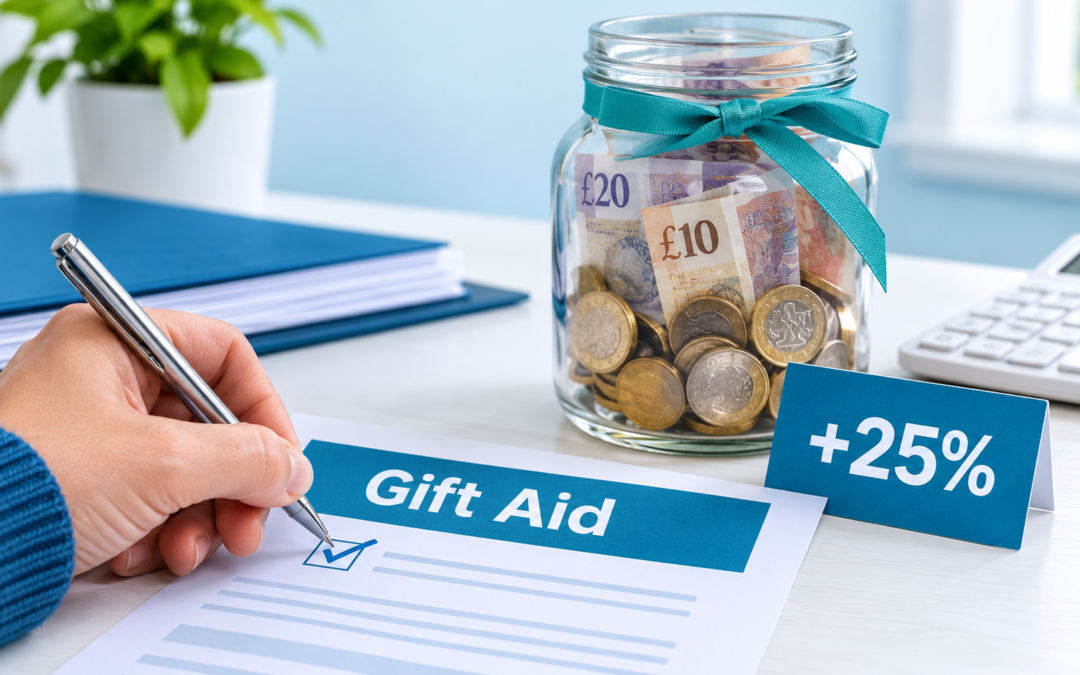
- Gift Aid turns a £100 donation into £125 for the charity, at no extra cost to a basic-rate taxpayer.
- Your Gift Aid donations must not be more than four times the Income Tax and Capital Gains Tax you paid in that tax year.
- Limited companies can deduct qualifying charitable donations from their total profits, subject to the tax rules.
- Sole traders and partners can only claim a trading deduction where a gift passes the wholly and exclusively test; personal gifts usually go through Gift Aid instead.
- Qualifying gifts of shares, land or property may attract Income Tax and Capital Gains Tax relief, subject to conditions.
- The recipient must qualify as a UK charity or, where the relief allows, a registered CASC.
Are tax deductible charity donations a thing in the UK?
Partly. Most cash gifts from individuals aren’t taken off your income. Instead, Gift Aid adds the basic-rate tax to the donation, and higher earners reclaim the rest. Qualifying gifts of shares or land, and donations by companies, are where a true deduction applies.
How UK relief differs from a US-style deduction
The phrase “tax deductible charity donations” comes from countries where people subtract gifts from their taxable income on their return. In the UK, a basic-rate taxpayer who gives £100 with Gift Aid pays £100 and gets nothing back personally. The charity claims £25 from HMRC instead, which represents tax you have already paid.
Who can claim: quick answers
- Basic-rate taxpayer: no personal refund, but Gift Aid increases what the charity receives.
- Higher or additional-rate taxpayer: yes, you can claim extra relief yourself.
- Non-taxpayer: don’t make a Gift Aid declaration unless you have paid enough UK Income Tax or Capital Gains Tax in that tax year to cover what the charity will reclaim.
- Sole trader or partner: personal relief through Gift Aid in most cases; a trading deduction only in limited cases.
- Limited company: yes, by deducting qualifying donations from total profits.
Six ways to get tax relief on charitable donations
When people search for tax deductible charity donations, they usually mean one of these six routes. Each one has its own rules, so start with the row that matches how you give.
| Route | Who uses it | How the relief works |
|---|---|---|
| Gift Aid | UK taxpayers giving to charities or registered CASCs | Recipient claims 25p per £1; higher earners reclaim the extra |
| Payroll Giving | Employees and pensioners whose employer or provider offers it | Taken from pay before Income Tax; charities only, not CASCs |
| Shares, qualifying land or property | Investors and property owners | Qualifying gifts to charities can reduce taxable income and may qualify for Capital Gains Tax relief, subject to conditions |
| Company donations | Limited companies | Qualifying donations deducted from total profits before Corporation Tax |
| Trading deduction | Sole traders and partnerships, in limited cases | Allowed against profits only where wholly and exclusively for the trade |
| Gifts in a will | Anyone planning their estate | Exempt from Inheritance Tax; may reduce the rate on the rest |
Charities and CASCs are not treated the same for every relief. Payroll Giving and the Income Tax relief on gifts of shares or land are not available for CASCs.
How Gift Aid works for individuals
Gift Aid is the most common form of tax relief on charitable donations. You sign a short declaration, the charity or CASC claims back the basic-rate tax from HMRC, and your gift grows by a quarter.
What the charity receives
Charities and CASCs can claim an extra 25p for every £1 you give, according to GOV.UK’s Gift Aid guidance. Each charity needs its own declaration from you, and a declaration can also cover gifts made in the last four years.
Claiming higher and additional-rate relief
If you pay tax above the basic rate, you can reclaim the difference between your rate and the basic rate on the grossed-up gift. For individuals, this is the nearest thing to tax deductible charity donations. Claim it in the charitable giving section of your Self Assessment return, or ask HMRC to change your tax code. If you don’t file a return, you can claim £5,000 or less by phone and larger amounts in writing.
• Basic rate (20%): no extra relief. Priya’s cost: £800.
• Higher rate (40%): she reclaims 20% of £1,000 = £200. Cost: £600.
• Additional rate (45%): she reclaims 25% of £1,000 = £250. Cost: £550.
The example uses the 40% higher rate and 45% additional rate that apply in England, Wales and Northern Ireland. Scottish taxpayers have different bands and rates, so their personal relief should be worked out from their actual Scottish tax position. Either way, the donor must have paid enough qualifying tax to cover the charity’s Gift Aid claim.
The four-times rule
The total of the donations covered by your declarations must not be more than four times the UK Income Tax and Capital Gains Tax you paid in that tax year, which runs from 6 April to 5 April.
If you paid £1,000 in qualifying tax, for example, Gift Aid can generally be claimed on up to £4,000 of donations. If a charity reclaims more than you paid, HMRC may ask you to make up the difference. Getting this wrong is the quickest way for tax deductible charity donations to turn into a bill.
Claiming relief a year early
You may be able to treat Gift Aid donations made in the current tax year, up to the date you file your return, as if you made them in the previous year. This helps if you paid a higher rate last year but expect to pay less this year.
You must make the choice on the earlier year’s return before you send it, and within the filing deadline: 31 January online or 31 October on paper. The donations from both years together must also pass the earlier year’s four-times test.
Payroll Giving and gifts of shares or land
These routes give relief at source. Payroll Giving needs no claim afterwards, and qualifying gifts of assets are the one case where individuals get genuinely tax deductible charity donations, often saving two taxes at once.
Giving straight from your pay
With Payroll Giving, the donation comes out of your wages or pension before Income Tax is worked out, although National Insurance still applies. GOV.UK puts the cost of giving £1 at 80p for basic-rate taxpayers, 60p at the higher rate and 55p at the additional rate.
There are two limits to know. You can’t use Payroll Giving to give to a CASC, so the money must go to an eligible charity. And because relief is already given at your top rate before tax, you can’t claim extra higher-rate relief on the same donation.
Shares, land and property
If you give qualifying shares, land or property to a charity, you can deduct its value from your taxable income for that year. You usually pay no Capital Gains Tax on an outright gift either. If you sell to a charity for less than market value, the gain is worked out on what the charity actually pays.
Not every asset qualifies. HMRC helpsheet HS342 (2026) lists shares listed on a recognised stock exchange or dealt on AIM, units in authorised unit trusts, OEIC shares and certain overseas funds. For land, you must give your whole beneficial interest in UK freehold or leasehold land, joint owners must all give, and the charity must provide a certificate. This Income Tax relief is available for gifts to charities, not CASCs.
Tax deductible charity donations for sole traders and limited companies
Here the rules divide. A limited company gets a genuine deduction for qualifying donations. A sole trader normally gets relief personally through Gift Aid, and only sometimes as a business expense.
Sole traders and partners
HMRC’s Business Income Manual confirms that gifts to charity can be deducted from trading profits, but only when made wholly and exclusively for the business. It lists signs that a gift may not be for business purposes:
- the charity has no local connection to the business;
- you have a personal connection with the charity; or
- there was no publicity around the gift.
These are pointers, not automatic reasons to refuse a deduction. HMRC looks at the full facts of each gift. A payment made for genuine publicity or another commercial return can be treated differently from a voluntary personal gift. Charity sponsorship that gives your business real advertising or promotion, for example, may be an ordinary business expense.
So tax deductible charity donations are the exception for sole traders, not the rule. Most personal gifts are best recorded as drawings, with relief claimed through Gift Aid on your Self Assessment return. Where you do claim sponsorship, keep evidence of what the business got back, such as the agreement, the advertising or confirmation that the charity promoted you. The tax treatment follows the real arrangement, not the label on the invoice.
Limited companies: qualifying charitable donations
For companies, tax deductible charity donations are a real part of the system. Qualifying donations are deducted from total profits when working out Corporation Tax, under section 189 of the Corporation Tax Act 2010. GOV.UK’s guide to tax when your limited company gives to charity adds:
- enter money, land, property and share gifts in the qualifying donations box of the Company Tax Return;
- the deduction can only bring profits down to nil, and any excess can’t become a loss or be carried forward;
- loans the charity must repay and dividend-type distributions don’t qualify;
- benefits the company gets back are capped, and gifts of shares in your own company don’t qualify.
Donations and sponsorship are not the same thing. A qualifying cash donation is claimed against total profits. A genuine sponsorship payment that brings commercial benefits, such as use of the charity’s logo or a link from its website, is deducted as a normal business expense in the accounts. Donated equipment the company has used may qualify for capital allowances instead.
Corporation Tax saved: £5,000 × 25% = £1,250. Net cost to the company: £3,750. The charity receives the full £5,000.
This assumes the company has no associated companies or other adjustments that change its thresholds, and that the whole donation qualifies. Real savings depend on the accounting period, taxable profits and the Corporation Tax rate that applies. A company at the 19% small profits rate would save £950 on the same gift.
Rates from GOV.UK Corporation Tax rates and allowances, checked 31 October 2026.
Should a director give personally or through the company?
Both routes can make tax deductible charity donations work for a director. The better option depends on your personal rate, the company’s rate and how you would otherwise take the money out.
| Point | Personal gift with Gift Aid | Company donation |
|---|---|---|
| Charity receives | Your gift plus 25% | The amount paid |
| Tax relief | Extra relief if you pay above the basic rate | Corporation Tax relief at the company’s applicable rate, subject to profit thresholds, marginal relief and associated-company rules |
| Paid from | Money already taxed as salary or dividends | Company profits before extraction |
| Paperwork | Gift Aid declaration; claim on your return | Board record and receipt; claim on the Company Tax Return |
If you’re weighing this up, our tax service for limited company directors can compare both options using your own figures.
Leaving money to charity in your will
Gifts to charity in a will are removed from the value of your estate before Inheritance Tax is worked out, as GOV.UK’s guidance on gifts in your will explains.
If your will leaves at least 10% of the relevant net value of your estate to qualifying charities, the Inheritance Tax rate on the qualifying part may fall from 40% to 36%, under HMRC’s Inheritance Tax manual.
The 10% test follows statutory rules and can involve separate parts of the estate, so have the calculation checked before relying on it. Legacies are often forgotten in conversations about tax deductible charity donations, yet they can make the biggest difference. Use the charity’s full legal name, and take legal advice on the wording.
Common mistakes with charity tax relief
| Mistake | What can happen | How to avoid it |
|---|---|---|
| Making a Gift Aid declaration without enough tax paid | HMRC may ask you to repay the shortfall | Check the four-times test each year |
| Forgetting the higher-rate claim | Relief you were entitled to is lost | Enter Gift Aid payments on your return |
| Booking personal gifts as a business expense | Expense disallowed if HMRC enquires | Record as drawings and use Gift Aid |
| Receiving benefits in return for a donation | Gift Aid or company donation relief may be restricted or unavailable | Check the donor-benefit rules and any company conditions first |
| Giving to an organisation that isn’t a UK charity | The gift may not qualify for UK charitable tax relief | Confirm it is recognised for UK tax purposes before claiming |
Good records protect your tax deductible charity donations if HMRC asks questions. Note the date, amount and charity for each Gift Aid gift, and keep the legal paperwork for gifts of shares or land. GOV.UK says individuals should keep share and land records for at least 22 months after the end of the tax year, and companies for at least six years.
FAQs: are charitable donations tax deductible?
Are charity donations tax deductible on my tax return?
Eligible Gift Aid donations and qualifying gifts of shares or land go in the charitable giving section of your Self Assessment return. Higher and additional-rate taxpayers can get further relief on Gift Aid gifts. The exact treatment depends on the type of donation.
Can I use Gift Aid if I don’t pay tax?
A Gift Aid declaration is only valid if you paid enough UK Income Tax or Capital Gains Tax in that tax year to cover what the charity will reclaim. If you didn’t, you shouldn’t make one.
Are charitable donations tax deductible for UK companies?
Yes. A limited company’s qualifying donations can be deducted from its total profits before Corporation Tax, but the deduction can’t create a loss or be carried forward.
Is sponsoring a friend’s marathon tax deductible?
A genuine donation through an eligible charity’s sponsorship page may qualify for Gift Aid if you make a valid declaration and get no benefits above the limits. It must be a gift to the charity, not a payment for goods, services or your friend’s own costs.
Do donations to overseas charities qualify?
For gifts in 2026/27, UK charitable tax relief generally needs the recipient to be a UK charity or, where the relief allows, a registered CASC. Under the rules in force since 6 April 2024, donations to non-UK charities generally no longer qualify.
Can a sole trader claim donations as an expense?
Only if the gift is wholly and exclusively for the business, which HMRC judges on the full facts. Most sole traders get relief on personal donations through Gift Aid instead.
How far back can a Gift Aid declaration cover?
A declaration can include gifts you made in the last four years, as long as you paid enough qualifying tax in each of those years.
Final Verdict: Tax Deductible Charity Donations Made Simple
Tax deductible charity donations in the UK work through several routes rather than one deduction. Gift Aid tops up personal gifts and lets higher earners reclaim more, Payroll Giving relieves tax at source, and qualifying shares or land reduce taxable income. Companies deduct qualifying donations from profits. Check the four-times test, keep records and claim on time.
- List this year’s donations and check each recipient qualifies for UK tax relief.
- If you pay above the basic rate, include your Gift Aid payments on your Self Assessment return.
- For company or large gifts, call 0116 4030595 or email info@majoraccountancy.com before you give.
Why trust this guide
- Written by Shahinur Chowdhury, a UK accountant at Major Accountancy.
- Gift Aid, Payroll Giving, asset, company and Inheritance Tax rules checked against GOV.UK, HMRC manuals and legislation on 31 October 2026.
- Covers individuals, sole traders, directors and companies in one place.
- General information only, not personal tax advice.
- GOV.UK: Tax relief when you donate to a charity
- GOV.UK: Gift Aid
- GOV.UK: Payroll Giving
- GOV.UK: Gifts in your will
- GOV.UK: Tax when your limited company gives to charity
- HMRC: HS342 Charitable giving (2026)
- HMRC: Gift Aid donor benefit rules
- HMRC: Restriction of charitable reliefs to UK charities
- HMRC BIM45072: Gifts to charities
- Corporation Tax Act 2010, section 189
- HMRC IHTM45001: Reduced rate for gifts to charity
- GOV.UK: Corporation Tax rates and allowances